Engine / Clutch – Continued

With the engine now containerized like some dodgy artifact in a museum, it’s my turn to review the pile of bits and start plotting the grand rebuild. First order of business: order the parts we think we know need replacing—because nothing says “confidence” like putting quotation marks around the word know—and then begin the glamorous job of cleaning decades of grime.

Some of the parts are on backorder, of course, but only 2–3 weeks. Which, in the world of vintage motorcycle restoration, is practically same-day delivery. Either way, they’ll arrive well before reassembly—assuming I don’t lose half the bolts down the garage floor cracks first.

Piston Rings

I wish my Father-in-Law was still around to fill me in on the “stories.” Funny how time slips by and it’s the little details you miss—the daft repairs, the shortcuts, the why on earth did you do that? I’m left piecing it together like some forensic mechanic, reading the tool marks and spotting the non-standard bodges. The piston, for instance, was definitely swapped at some point. Back in the early ’60s, that was no big deal—most bike owners knew how to change pistons and rings. Getting more than 30,000 miles out of one was pure fantasy. These days, engines happily chug past 100K, and most owners think “maintenance” means changing a lightbulb or trading the whole bike in for a shinier one. The art’s been lost, along with the smell of burnt oil baked into your fingernails.

Here’s Mario checking the piston-to-cylinder gap with a set of shims. We could squeeze the piston in with 0.003″, but it refused to slide through. At 0.005″ it was just loose enough to remind us we weren’t working with Swiss watches. That gave us our working range.

The plan now is to hone and clean the cylinder, which, of course, will probably nudge the gap a little wider. Nothing like a bit of suspense to keep the rebuild exciting.

And this is where the “science” (or, more accurately, years of stubborn trial and error) begins—with the rings. The piston is a +020, the first step up from factory STD. Back in the day, BSA gave you STD, +020, and +040, before politely suggesting you re-sleeve and start again at STD. Since this engine was running well enough before, this is really more of a maintenance check, made necessary by the 55+ years it spent sulking in a shed. The cylinder only needed a light deglaze/hone, and the piston itself was still in good nick. But either way, there was no way we’d reuse the old rings—they’ve had their day.

This piston has three grooves: the top two take identical rings, and the lower one is for the “oiler,” complete with a dainty little spacer. (See linked piston image for your daily dose of vintage metallurgy. – My piston diagram)

Here is a link to a youtube that explains a lot, but you may not have time or interest as it’s getting deeper into the advanced mechanic / engineer details.
Piston RING GAP – HOW and WHEN to adjust it + GAP CHART – BOOST SCHOOL #6

The rings, in case you missed piston school, do two very simple but life-saving jobs: they dump excess heat into the cylinder wall (since this engine is air-cooled and couldn’t chill a pint if it tried), and they keep combustion gases from sneaking past the piston like freeloaders at a football match. Trouble is, metal isn’t really solid—at least not when it’s getting roasted alive—so you have to allow for expansion between “sitting pretty” and “running like hell.” That gap will close up as the engine heats, and if you don’t leave one, the ring ends will crash into each other, buckle up or down, and shove against the ring lands. I’ve seen the aftermath: entire pistons turned into confetti. The last thing an engine wants is chunks of feral metal bouncing about in the combustion chamber.

So, instead of +020 rings (which might leave us with a comedy-sized gap), Mario suggests we go with +040 rings and file them down to fit. Custom job. His rule of thumb is about 0.002″ per inch of bore diameter. The ring manufacturers, naturally, insist on 0.004″ per inch. Who’s right? Neither, both, and somewhere in-between. Like most things with these bikes, it’s a cocktail of theory, trial and error, and the grumpy wisdom of mechanics who’ve been at it since the ’60s.

For now, I’m holding off on ordering the rings until we’ve cleaned and honed the cylinder, so we can actually get accurate measurements instead of guessing and praying.

To the left, you’ll see the clutch pressure plate—posed with four driving plates stacked up like pancakes and five driven plates sulking in the background.

I gave the driven plates a spa day with some very fine 140-grit sandpaper, just enough to scrape off 55+ years of fossilized muck. The driving plates still need their cork thickness checked, but at a glance they look fine—like they could actually do their job without bursting into tears.

Word on the street (or at least on the internet, where truth and nonsense live side by side) is that finding good-quality clutch plates these days is a right pain. So the fact mine cleaned up nicely feels like winning the lottery—minus the money, glamour, and champagne. The bright side? They’re dead easy to remove, replace, and adjust… or so I say now, before future-me learns otherwise the hard way.

Shiny Wheels (Rims + Spokes + Hubs)

When I was scrounging for parts, I hauled my wheels up to Walridge to see if any of the $109 specials they had lying around would fit my bike. Spoiler alert: they didn’t. But after poking about with Mike, we confirmed both of mine are WM2-18 rims. Naturally, they’ve got different center hubs and probably demand different spoke packages—because BSA never missed an opportunity to complicate a simple job. Forty spokes apiece, just to keep me busy swearing.

A quick bit of math (or masochism) tells me new rims are $149 each, plus about $85 for a spoke set. That means I’ll need to strip the hubs, restore them, and then rebuild the wheels from scratch. And let’s not forget to measure the hub offsets—usually 3/16″ or 1/8″ from centerline—because nothing says “fun weekend” like trying to true a wheel that’s fighting geometry itself. All in, it’s about $250 per wheel, plus elbow grease and a steep learning curve. The old rubber might do for a couple of trial runs, but after that I’ll need new tires unless I fancy sliding into a ditch on 50-year-old rubber.

Tools – Construct

Up front, the job is to replace the seals; in the rear, it’s mostly about polishing up the chrome “decorative” bits—which is just BSA’s way of saying extra parts to rust and annoy you. Of course, both ends require some bizarre, special tool to disassemble. Because why would you use a wrench when you can invent medieval torture devices instead?

So, off I went to the Metal Supermarket and picked up a couple lengths of pipe to sacrifice in the name of engineering. The plan? Start grinding and hack-sawing away until the tool I need finally emerges from the scrap, like Excalibur from a block of steel. More details to follow—assuming I don’t saw through something vital, like my patience.

The Adventure shall continue….

Posted in Uncategorized | Leave a comment

Engine / Clutch dismantle… (beginnings)

As many of you might recall from my dusty, pre-blog archives back in July, I somehow managed to get the engine coughing into life and the wheels to roll… which, let’s be honest, is the sort of miracle usually reserved for church fairs and tax audits. At the time, the blog wasn’t even a twinkle in my eye, so this is me playing catch-up—and trying not to fall asleep mid-story.
Push me Bohdan…. | BSA B40 350 Star

The grand plan had been to get the engine running before throwing more of my hard-earned cash and hours into this temperamental hunk of metal. Once that miracle occurred, I started tearing it apart, built an engine mount, and wrestled the engine out like it owed me money. The dismantling continued, mostly because the engine seemed to have a personal vendetta against me. I’d roped in my friend Mario—respected motorcycle mechanic and part-time saint—to help with the teardown and inspection. By now, I knew the clutch had decided to retire early: couldn’t pull it in, couldn’t roll the bike, probably sipping whisky in some long-forgotten corner of the gearbox. The transmission, on the other hand, appeared compliant enough to let me shift gears, which gave me hope. I even tried the old “kickstart while in gear” trick to loosen the clutch, but no dice—those 55+ years of hardened oil had turned it into something that could probably hold a castle gate shut.

I started by removing the timing cover… and I have to confess, I’ve never witnessed such a display of butchery on a set of Phillips head screws. It makes me think of what the outcome of a toddler wrestling a hedgehog might generate.

Enter the mysterious savior: the impact screwdriver. Who knew such a thing existed? (Apparently everyone except me.) You shove a Philips hex bit in, give it a whack with a BFH—Big Frickin’ Hammer, for those not in the know—and some clever little wedge inside magically imparts a twisting impact to the screw head. It’s a last-resort kind of tool… which, given the state of those screws, we were happily treating like a starter pack: maybe 6 out of 10 “last resorts,” and still counting.

I didn’t take many photos—nor did I bother with a video—because I was moonlighting as Mario’s apprentice mechanic. He was doing his best to keep his hands pristine, while I got to enjoy the full spa treatment of grease, grime, and questionable fluids.

If you squint at the clutch plates above, you’ll see the lovely little marks in the middle—souvenirs from 55+ years of cork-on-steel romance. There’s five steel friction plates and four double-sided cork plates, which, if you’re lucky, do a decent job of politely telling the engine to stop shoving power into the transmission when you pull the clutch. It’s one of those rare moments when I puff up with pride for being a Mechanical Engineer… and then immediately miss the good old days of manufacturing, before reality decided I should wrestle ancient BSA components instead of designing shiny new gadgets.

We didn’t dig too deep from this side—mostly because I was still trying to figure out which end of the engine to curse at—but a few nuggets of wisdom emerged:

1) The wire covering on the stator wires had apparently spent 55 years sunbathing and hardening into something approaching granite. Mario, in his infinite wisdom, suggested a heated razor blade to slice it off and free the three rebellious wires from the generator. Once liberated, a bit of new shrink wrap should keep them behaving… for now. If the wires throw a tantrum later, there are ways to cut back and resolder, but we’re hoping for a temporary ceasefire.

2) The primary chain—aka the timing chain—will need a proper once-over to check if the slack has exceeded BSA’s original specs. Shortening might be in order. In my later deep dive through the paperwork, I stumbled upon a service sheet. Seems BSA, realizing their earlier engineers might have been slightly optimistic, added a tensioner shortly after launch. Our engine, number 1318, just missed the memo; the sheet applied to engines 2501+. Mario was suitably surprised, and I felt like the poor sod had been handed a puzzle missing half the pieces. A retrofit is apparently in order—because of course it is.

The image on the left is about as revealing as a politician at a confession booth—turns out the outer cover hides bugger-all, since the next layer leads straight to the transmission. Since I could still shift gears (miracle of miracles), we decided the clutch was the main culprit and deserving of our full, greasy attention. For now, we buttoned it all back up and turned our sights to the top end—the valves, piston, and all the bits that like to remind you how much fun “disassembly” really is.

Mario, ever the sadistic mentor, assigned me “homework”: document the piston and start hunting for rings. Turns out we had a +020 piston—a hair bigger than the as-shipped STD. The piston itself is fine, but Mario reckons we might go bold with +040 rings and carefully size the ring gap… because apparently, measuring tiny gaps on a component that could have served as a medieval torture device is the height of fun. More on that nightmare later. (also reduces the risk of the +020 installing with a larger than desired/expected gap – I trust his experience over time)

I reached out to Walridge for parts, since we were replacing the exhaust valve, intake valve, and one particularly stubborn valve guide. A few other bits were on the shopping list, but those were the headliners. I asked about the ring set, and Mike—ever the practical joker—pointed me to a contact in the UK. Of course, why bother sourcing parts locally when you can wait weeks for international shipping and a generous side of jet lag for your patience? (Probably also because Mike didn’t have any on hand—he might sell his own teeth if anyone asked – for the right price.)

From: coxandturner.co.uk

You have a Hepolite #15544 +020 piston, so you need two 79.5 x 1/16” x .127” comps and a 79.5 x 5/32” x .127” oil. We wouldn’t advise gapping a +040 set down as the rings will just go out of round, if they don’t just snap when you try and fit them. Any spacers in te iol groove need to come out; our replacement oils are one piece slotted cast iron type, as were originally fitted.

To Be continued….

Keep following… so good to have you read this far… Thanks for the replies of encouragement I’ve received

Post is getting too long and would hate to lose your attention… more to follow

P.S. Attaching in pdf the presentation that Eleanor and I provided to the CVMG London section club… they were very pleased and it seems I’ve inspired some that wish to document their projects… lets see.

Posted in Engine | Leave a comment

Swap Sales – late 2025

Apparently the best swap sales are in the spring, but I was still waiting on the bike to arrive on the shipment to know what parts I needed. In September I was going to be able to catch two of them.

September was a busy month — I had the chance to hit two swap sales. The one on the left was first, the one on the right still to come.

Mohawk was the first outing. Luck wasn’t exactly on my side, but at least I had Mario along, and that was a godsend. The man knows his parts. I was on the hunt for exhausts, a seat, rims, and even a replacement Ammeter. What did I actually manage to drag home? An old 1961 BSA spec book — basically a paperweight with more dust than answers, but hey, a bit of history for the collection.

Mario, meanwhile, walked off with a full set of chromed dual exhausts for one of his bikes — $50. He didn’t even need them, but he negotiated like a pro until the poor seller caved. Formula for discounting: pretend you don’t want the thing, then buy it anyway.

Mario reckons the supply of British parts is starting to get thin. Makes sense — it’s been over 60 years since these bikes rolled out, after all. The tables were full of Japanese bits and Harley parts, most of which, judging by their condition, probably fell off on the highway and were scooped up for resale.

So, reality check: I may have to look at replica parts over the winter for some of the rarer components. “Made in India” instead of “Made in England.” At this stage, I’ll take whatever works, so long as it doesn’t explode or look like it was stamped out of tin foil.

Enough for now — next up: the engine dismantle. It’s already done, but I’ll try to recall the pain without bursting into tears.

Fair warning: it involves seized bolts, questionable engineering, and enough swearing to make a docker blush. Stay tuned.

Posted in Uncategorized | Leave a comment

More progress… just keeps coming…

Of course like anything it takes time….

Course, like anything worth doing, it takes time… and in my case, a few muttered curses and a good helping of misplaced optimism.

First order of business was to get the wheels off the rims and the tubes out. Aye, tubes — remember those? Back in ’61 they actually put a balloon inside the tire to hold the air in. Revolutionary thinking, clearly. Likely the only reason the blessed things were still holding air after 55 years. Fair play to the old rubber, it had more stamina than me.

Before heading off to the swap sale recently, I figured I should at least take a squint at the spokes and how they were mounted. Couldn’t just walk in pretending I knew what I was talking about — though, truth be told, that’s usually my approach to life. So, off came the tires for a closer look.

Now, I’ve done plenty of bicycle tires in my day — usually with screwdrivers and my mum’s best butter knives (sorry, Mum). I was the local bike repair lad back then. Paint a frame, fix a chain, bodge a repair. I was also head demolition expert, but that’s another tale. Anyway, I quickly discovered that my trusty screwdriver wasn’t up to the job. In fact, it was about as useful as a chocolate teapot.

So I asked my mechanic pal Mario how he does it. He agreed to lend me his secret arsenal: three proper tire wedges and his personal BFH — that’s “Big Friendly Hammer” in polite company.

Like a Scotsman at an open bar, I was off.

Attack!

I’ll spare you the details of the huffing, puffing, swearing, and sweating as I tried to balance three tire wedges while whacking away like a man possessed. There are entire YouTube channels dedicated to this lunacy, if you fancy seeing other poor souls suffer. But the good news: I was successful. Even better news: I didn’t put any new holes in the tubes. (The old ones will do just fine, thank you very much.)

The rubber is older than a Highland granny, but I reckon it’ll be good enough to get the bike rolling. Once the test pilot’s done, we’ll swap it out for something a wee bit fresher — ideally before the thing disintegrates mid-ride and throws me (or the wifey) into a hedge.

Next came the delicate art of finesse — which in my case usually means brute force with a thin veil of patience. The two hub covers had to come off, and after a bit of persuasion with heat and a pair of wedge screwdrivers (the sort of nail pullers your grandad kept in a rusty tin), I managed to pry them up bit by bit. The heat worked its magic, softening the 50-year-old grease into something resembling day-old porridge, and slowly but surely the covers gave up.

With that, I coaxed the shaft and bearing out of the hub. Well, coaxed might be generous — let’s just say there was some convincing involved. The second bearing I left for a trip to Mario’s, since he actually owns a proper drift for the job. (I’d been about ready to try a tent peg and some choice language, but apparently there are “correct tools” for these things. Who knew?)

I’m down to a couple of tough ones remaining on the dismantle (other than the engine inspection)

Anyway, this race has to come out. Only problem: the frame hole is smaller than the inner race ID, so there’s no handy lip to tap from the other side. In other words, BSA designed it so you’d curse your way through the job.

At coffee morning, the lads told me the trick: put four spots of weld on it and, when it cools, the different metals shrink at different rates and the race just drops out. Aye, right. Sounds like black magic to me. I’d hate to dig out my book on thermodynamics (or worse, ask my wife to explain it).

Plan B: weld a big washer or nut across the race so it can actually be hit with a drift from the back. Or maybe it just falls out on its own when I’m not looking — that would be a first.

The other job (I did say two remaining) is to get the front and rear shocks broken down. Since the springs are under more force than a Scotsman guarding the last biscuit, special tools are required. Naturally, I’m making my own.

For the fronts, I’ve got to reach way down the tube to hook into those two opposing slots using the tool on the right — essentially a bit of pipe ground with two tabs. Then I can grab it with a plumber’s wrench and twist it free. The “proper” tool for the job is $126 CAD on eBay (plus shipping). Aye, very reasonable… if you’re daft. I’ll be making mine for the price of a bit of scrap pipe and a fresh blister.

The rears are trickier. I need to build a special pipe to compress the spring so the two chrome pieces pop out through the gap. Sounds simple, right? Right. Wish me luck — because the only thing standing between me and a flying chrome projectile is my homemade contraption and blind faith.

If you don’t hear from me again, assume one of the 4 the springs won.

Posted in Uncategorized | Leave a comment

Speedo & Tires removal….

And the fight to get complete continues.

CVMG September monthly meeting

Eleanor and I attended the September CVMG meeting for London this week and presented the BSA project at their request. I brought along the DELL projector I’d repaired a couple of years ago, and we threw our PowerPoint up on the wall. I think it’s safe to say everyone now knows who the “technology people” are… lol.

Attendance was solid, and folks seemed genuinely pleased with the story, the details, and the progress (or at least the drama) of the B40. I shared a link to the blog so they can subscribe and follow along—assuming, of course, they can wrestle with the mysteries of the internet.

A great side-effect: now everyone knows what’s on my parts shopping list. That means more eyes on the hunt! Pete, one of the members, even mentioned he might have a silencer (aka muffler) that would fit. If that pans out, all I’ll need is the connecting pipe from the engine to the silencer—whether that ends up being found, bought, or fabricated. Either way, it feels like a promising lead.

Speedometer drive

The BSA B40’s speedometer drive is one of those little gadgets that you don’t think much about—until it isn’t there. It’s a Smiths-style mechanical unit, tucked away on the rear wheel axle, quietly converting every turn of the wheel into a spinning cable that feeds the speedometer.

Inside, a drive ring turns a worm gear, which spins the inner cable, which spins the speedometer needle. Simple enough in theory. In practice, it’s a fiddly piece of kit that can slip, bind, or just decide it’s had enough after 60 years of service. Many riders from back in the day will remember watching the needle bounce around like it was measuring earthquakes rather than road speed.

But when it works, it’s a clever little link between man, machine, and velocity—one that was shared across many of BSA’s unit singles, including the B40. And it’s matched to magnetic Smiths speedometers, which means the right drive ratio, cable, and sleeve nut all need to play nicely together.

When I got this bike, the speedometer cable was already disconnected. That makes me wonder if my late father-in-law had already had his own battles with this setup and decided to quietly declare a truce. Time will tell—my next step is to hook the cable up to a drill and see if the speedometer needle even twitches. If it doesn’t, well… that’ll be another chapter in the saga.

So, while some might dismiss it as just another widget, I like to think of it as the unsung hero that keeps you from being “that rider” explaining to the constable, “Well officer, I didn’t realize 45 felt so much like 65.”

My goal here was to remove the speedo unit so that I could remove the then sheet metal decorative cover. Would be required to access the spokes if removing and needed to clean both. It should just slide up, but I struggled to gently pry it with 2 and 3 lifters. After discussions with everyone gentle pressure, light oil, persuasion was the suggestions (no tricks) and don’t use heat or break the unit… OMG

Speedo to be continued.. Friend arrived for a late afternoon Virtual Pinball competition in the basement… BSA later.

Saturday.. continued

One thought I’m entertaining is the idea of sandblasting and powder-coating the existing rims, spokes, and center hubs. That would give me a solid “version 1.0” of the rebuild—good enough to get the bike rolling and respectable—while I keep hunting down new chrome rims for a proper “version 2.0.” The math is simple: rims are about $150 plus shipping each, then I’d still need new spokes, a cleaned-up hub, and someone skilled enough to true the whole assembly. Powder-coating what I have now could save a lot of time and money while still looking sharp-ish.

My BSA friend Mario (from CVMG) offered to loan me his professional tire removal tools, so when we met up at the weekly McDonald’s coffee gathering, we did the handoff in the parking lot like a couple of shady parts dealers. We’re also heading together to the Mohawk Racetrack swap meet on Sunday morning—perfect timing to strip these tires off and see what I’m really working with.

Side-tracked: Of course, before I can focus on the BSA, my neighbor Cal roped me into helping with his “new to him” 1982 Yamaha XS400. He recently got his M2 license and was excited about his vintage purchase (yes, it technically qualifies now—yikes). The problem was it refused to start, either on kick or electric. He’d told me the electric starter didn’t work, but I suspected it was more a case of a weak battery than dead electronics. Sure enough, after a night on my trickle charger, I hit the button and it fired up. We used our planned time and tackled a front brake job and made a punch list of what he’ll need before a Service Ontario inspection. A good day’s progress for him.

Now—back to the BSA. Tires to come off, and time to put that speedometer drive mystery to the test.

The tools are in the collection of images above—the pry bars and the hammer for breaking the bead (or persuading stubborn rubber to move when needed). They worked beautifully, and the job went surprisingly well. The rubber is in decent shape, but I’ll definitely be scouring the swap meet for tires that are a little younger than half a century old. Still on the to-do list: getting the bearings and shafts out of both wheels.

I set up the rear wheel on a 4″x4″ block and was able to drive the shaft down, which let the speedo drive pop right out. (Naturally, I only remembered to take the photo after flipping the rim around—classic move.)

Both tubes look fine—one even has an old patch—but since they’re holding air, I’m calling that a win.

As a bonus, I also managed to wrestle off the decorative hub covers. That took some creativity: two nail puller tools working around the edge while I blasted the cover with a heat gun to soften the ancient goop holding it in place. A few bent edges near the spokes needed some coaxing too, but eventually they surrendered.

After a few hours I had both rims broken down. One still has the shaft and two bearings stuck inside, while the other is clinging to a single bearing. Looks like it’s time to invest in some proper tools—brass drifts and bearing installers—if I want to finish the job cleanly.

And yes, at this point I think the bike is keeping a running tally of how many tools it can trick me into buying.

So that’s where the B40 saga sits for now: parts spread across the bench/floor/garage, bearings still to be evicted, rims stripped down, and a speedometer drive that may or may not cooperate when I spin it with a drill. It feels like progress, though in the same way a Highlander might feel “progress” climbing Ben Nevis in the rain—you’re not sure if you’re winning, but you’re definitely wetter and tireder than when you started.

Still, every step forward matters, and with swap meets, kind friends lending tools, and the occasional bit of stubbornness, this old BSA will come back together. In the meantime, I’ll keep smiling, keep hammering, and keep reminding myself: it’s only vintage motorcycling—nae brain /brian surgery.

Or as a Scot might say, “If ye cannae fix it wi’ a bigger hammer, maybe ye dinnae own enough hammers.”

Fingers crossed for the pending Swap Sale….

Posted in Uncategorized | Leave a comment

Frame finale!… Almost

So, progress today — I managed to get the frame down into its 3 major pieces. Not only is it now ready for powder coating (should I decide to get fancy), but I can also say with a straight face that this motorcycle is now officially ready for the prep to enter the next 50 years. Whether I will be is another matter entirely.

I also tackled the front wheel hub. Here’s how it went down:

Front wheel Hub / brakes

This is the circlip after removal. Finding the holes in it required more cleaning than I’d like to admit — let’s just say the last person in there was probably still listening to The Beatles on vinyl. Once located, I gave it the screwdriver + pliers treatment. (Think surgical precision, but with more swearing.)

Out will come the bearings next (another day)… at least in theory. To hold the shaft steady, I used my vice, some 2×2 wood pieces (yes, that’s considered “precision engineering” in my garage), and hit it with my trusty electric heater. With a plumbing pipe extension on the wrench, the nut finally surrendered — apparently convinced that resistance was futile.

Springs and shoes followed. The toughest bit? That one pin that doubles as the brake cable guide. I’m convinced the engineers at BSA made that part specifically to test my patience. I almost succumbed.

Frame from 1 to 3 pieces

Next job: splitting the frame. (A, B, C) It pivots at two points, so it was just a matter of driving out a pressed-in tube with a screw, a 5 lb persuader (a.k.a. mallet), and the usual accompaniment of heat. Success!

The bolt holding on (B) to (A) was a bolt and nut but it passed through a tube which was pressed in through the two side arms as well as through the core Frame. I found a screw that had a head which was just smaller than the frame but the thread went into the tube. I used this to drive the tube out using a screwdriver and 5# mallet (persuader) while supporting the back and applying heat with my electrical heat gun. — Success

Next came what I figured would be the most difficult. The Swing Arm Spindle. In the two ends of the swing arm are bronze bushings which the thin bushing can be seen in the two images below showing the spindle end where it accepts the bolt. I found a socket that is a smaller diameter than the bronze bushing, but will push the spindle end. On the bottom I put a socket large enough to accept the shaft as it would come out.

I was intending to use my heat gun but my neighbor had a very handy small propane blow torch so we used that and with 4 hands he could be “heat man” whilc I was BFH man. I destroyed one socket (although I think I can fix the end with a grinder) while pounding, but after continuing with heat and shock waves the shaft started to move. Once it moved a little then it had to come out. Few repositions to get more height for the shaft and quite a few smacks it left it’s home for the past 50 years.

The Service Sheet Revelation:

Turns out my frame (B40-1296) predates a later revision. The manual actually recommends drilling two new grease nipple holes and plugging the old one. Sounds like a weekend project waiting to happen. (What could possibly go wrong with me and power tools?)

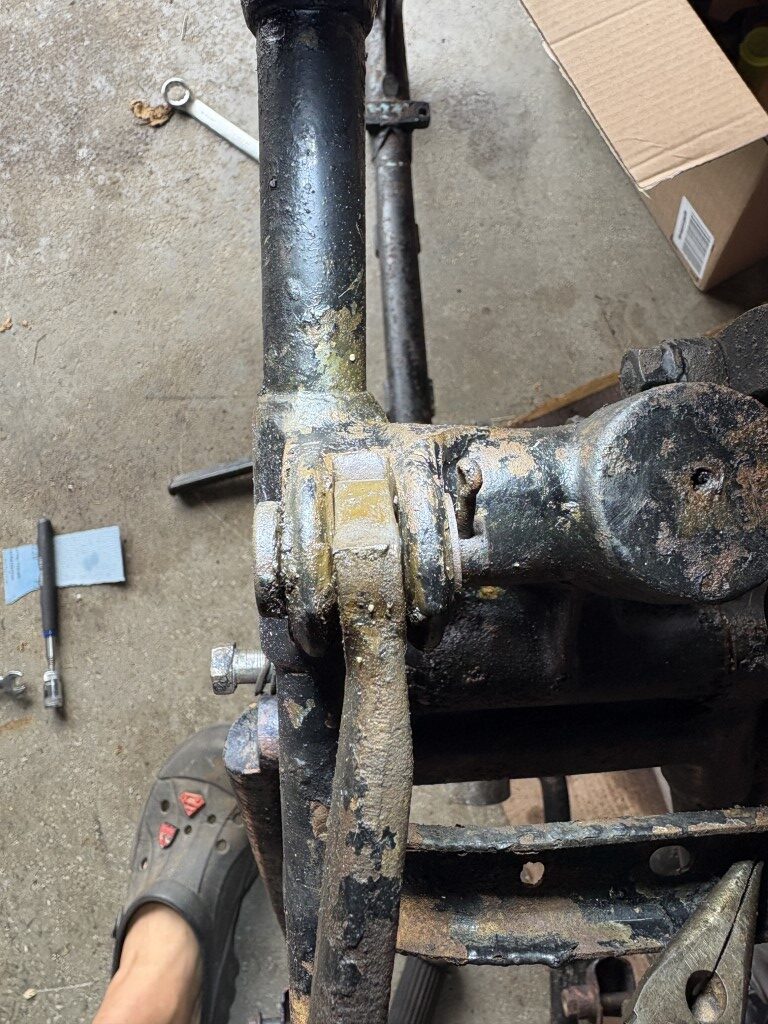
In this photo I placed the swing arm spindle back in the swing arm and placed in on the frame to show where it would pass through. You can see the single grease nipple which is offset and might struggle to push grease to both bronze bushings.

The retrofit would be to drill two nearer to the bronze bushings to better allow each bushing to be greased.

Blow Torch – Reference

Because nothing says “midlife motorcycle restoration crisis” like unwrapping a blowtorch on your birthday. 🎂🔥

Posted in Uncategorized | Leave a comment

Small items – Swan Neck / Front Hub

Was tackling yesterday an issue with the Vulcan 800. Had to 3D print some new components for the rear signals, but that’s another story and maybe I’ll post about that, but want to stay focused on the BSA here.

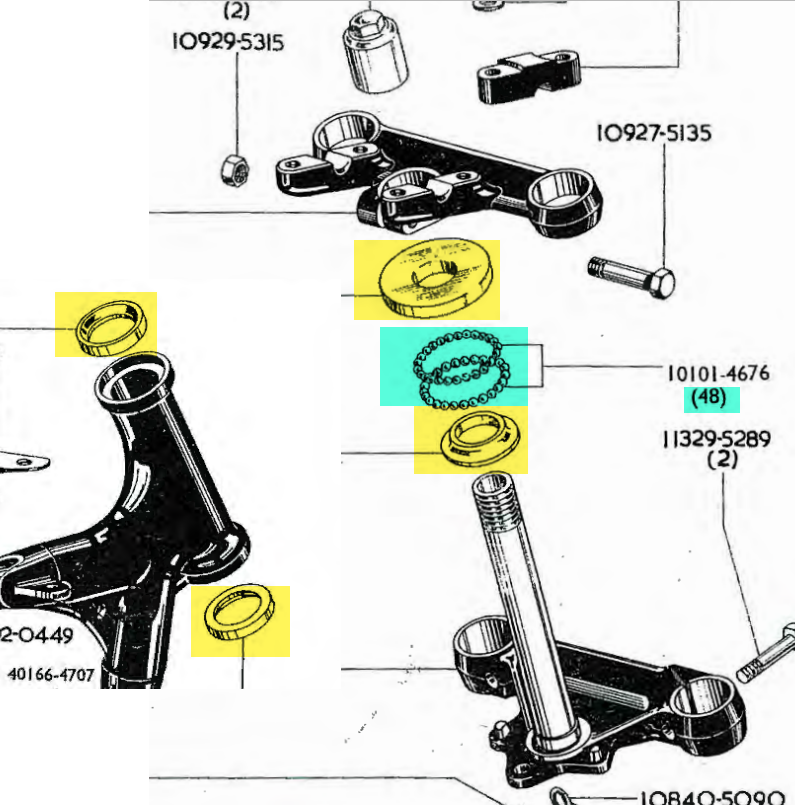
Today I wanted to get ready to rebuild the front end so had to complete the disassembly. Since I’m down 3 bearings of the 48 and likely the ones left are bad I’m planning 4 new bearing races and new ball bearings. For this I had 3 of the 4 races that need attention.

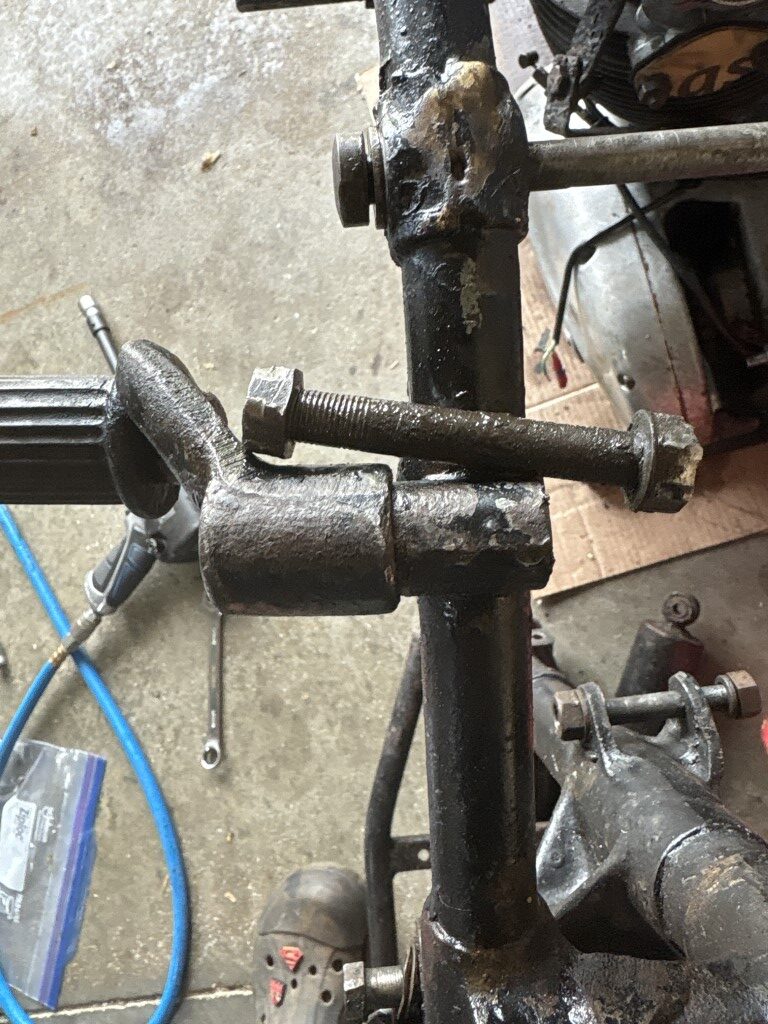
To the left you will see the race is now dropped from it’s original location. With the neighbor we put it vertical in a vice and then used his torch to heat up the race. Once glowing we poked a flat screw driver in the top gap and it fell from it’s location.

You can see a slight step so putting the new race on it will be critical to get the right size pipe to assure even pressure. Another day.

This is the 4th bearing race which is at the very top of the swan neck and it has a decorative dust cover on it, so this is a direct order / replacement.

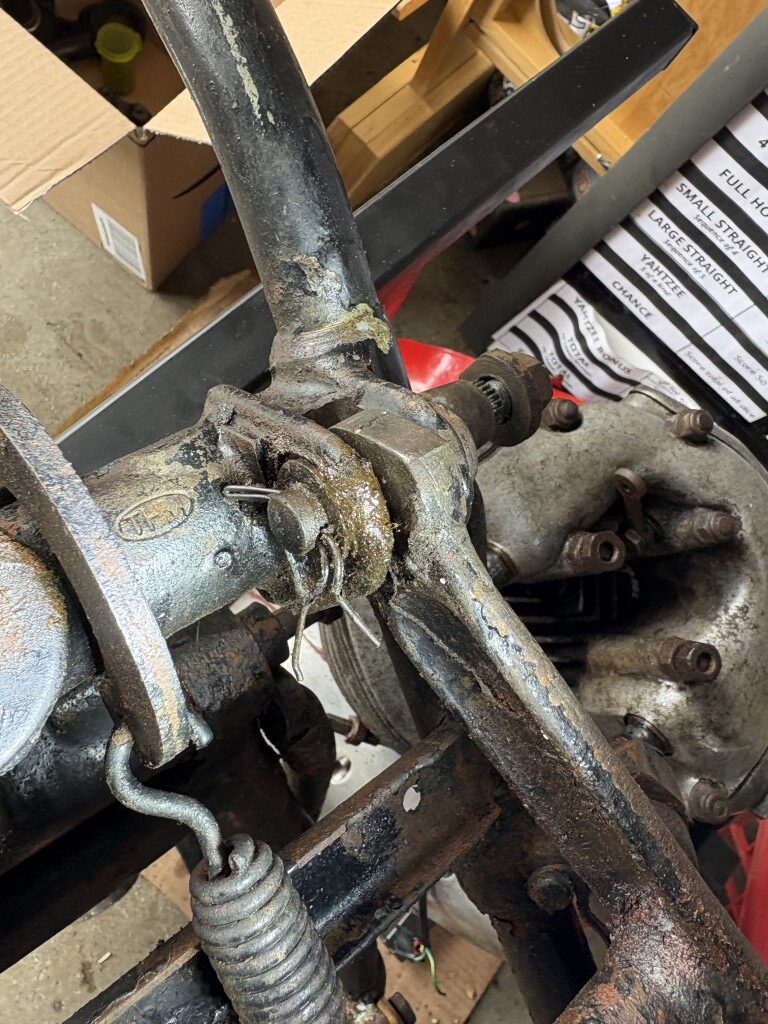
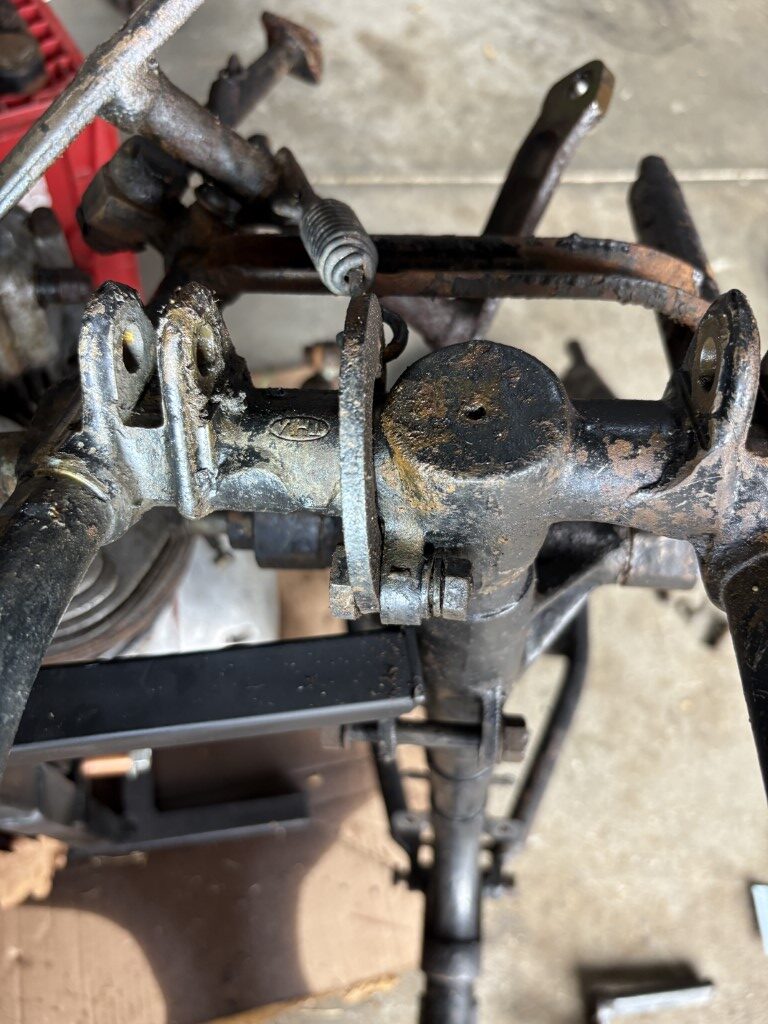
The Nut to be removed is shown in the above in yellow and in the actual image to the right. It’s being very stubborn and I was starting to think it was a LH thread, but seems that the foot peg Nuts have an LH stamped on them and this Nut does not. All signs point to it being just stubborn so tomorrow I go to Crappy-Tire and purchase a 1-1/8″ deep socket 1/2 drive so that I can use my pneumatic impact gun.

I found a similar video as it’s a BSA A10 and not the B40, but the wheel is identical and the 7″ FULL Hub, so I suspect it’s relevant. He has a series of these videos on his bike, so will be going through them to see what is relevant. I’m considering doing some videos in the future and edit them down to relevant content.

The front hub is similar to the rear hub was and needs to be cleaned and freed up, so I must make entry :o)

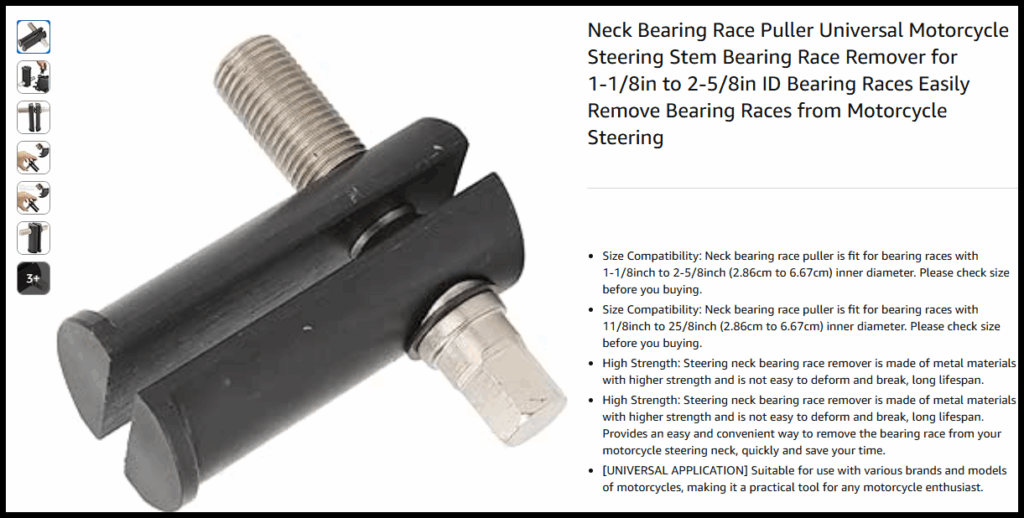
As for the remaining bearing races in the swan neck I’ve ordered the above tool from Amazon which can be used grip the small edge of the race in the neck pipe and then it can be drifted from the other end with a persuasive BFH. My opening is 1-1/4″ so this one should work fine and my neighbor can borrow it in the future for his Vintage BMW.

Neck Bearing Race Puller Universal Motorcycle Steering Stem Bearing Race Remover for 1‑1/8in to 2‑5/8in ID Bearing Races Easily Remove Bearing Races from Motorcycle Steering, Bearing Pullers – Amazon Canada

Another future consideration is whether to remove the swing arm assembly. The arrows point to where there are bronze bushings and the red line is where a spindle goes through.

I’m going to investigate this more as right now the swing arm is moving without any trouble and this assembly might not be worth the rebuild now. The spindle might be useable, but the bushings might need to be replaced and then honed to be true. I also found there was a service bulletin shortly after this frame where they changed from the one grease nipple shown to two at the outer edges… this might be a future strip down and winter repair if it gives trouble… still time to think.

BTW.. the reason for consideration was for powder coating if I went that way as the heat and process might cause issues. I read in this bronze assembly it’s unlikely, but future methods changed where a rubber bushing was within that could melt.

Swap meets coming up, so need to focus on making a list of components I’m looking for and get some basic measurements. Sunday Sept 7 and Sunday Sept 28th… fingers crossed.

Posted in Uncategorized | 1 Comment

Foot peg removal… success!

We last left our story where I was contemplating how to remove the foot peg now that the reverse-thread bolt had been conquered. Several whacks with the BFH (Big F@$#% Hammer) had already been administered, but the peg responded with the enthusiasm of a teenager asked to mow the lawn. A good night’s sleep seemed wiser than escalating to arson with a blow torch.

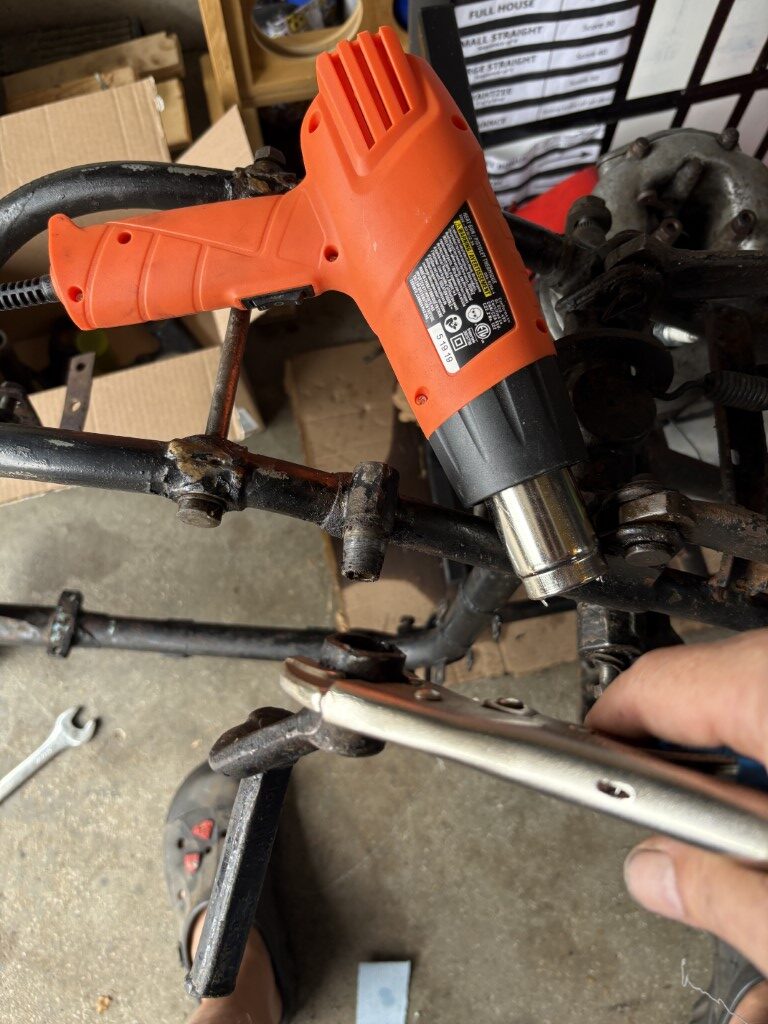
Enter the heat gun. Not the kind of blowtorch you see in proper garages—no, this was the Princess Auto shrink-wrap special. Normally used for scaring plastic electrical tubing into submission, today it was promoted to “fire-breathing dragon.” A little heat, a twist with the vice grips, and—presto—it surrendered without another whack. The BFH sat sulking in the corner, muttering about “how things used to be done.”

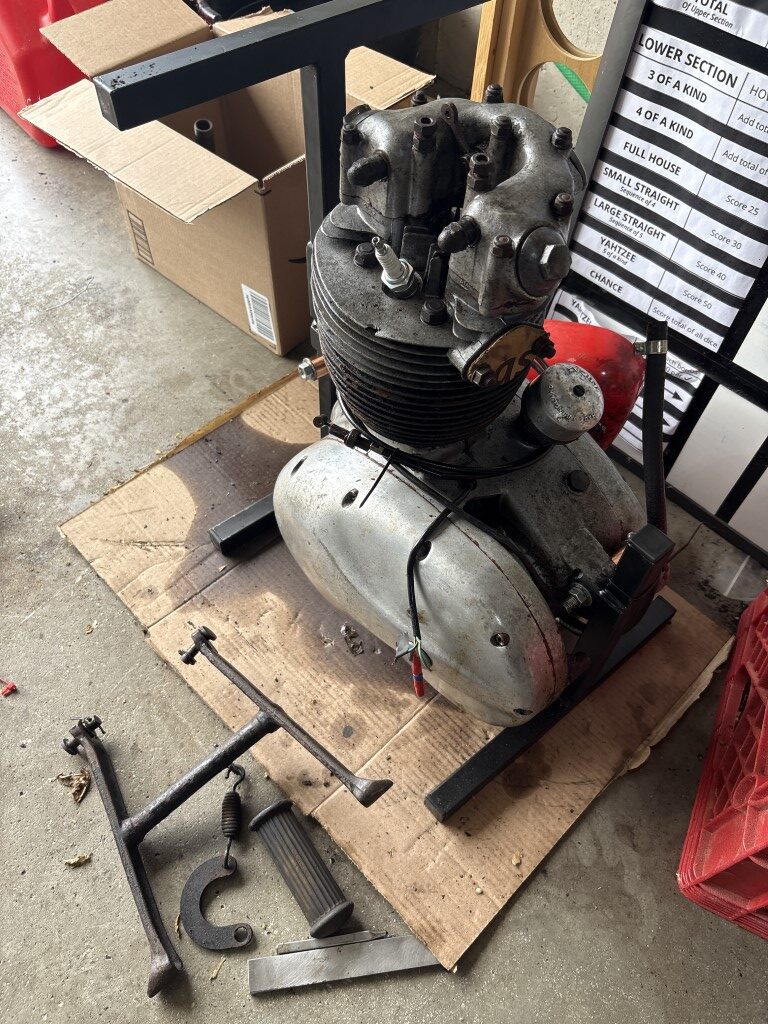
Feeling smug, I moved on to the center stand and side-stand. Both were coated in what can only be described as “archaeological grime,” possibly dating back to when Elvis was still touring. They eventually came off, leaving me with photos that look suspiciously like the “before” side of an infomercial.

Next will come the bearings. Oh, the bearings. Forty-eight ball bearings were promised, but only forty-five were accounted for. Three apparently decided to defect—possibly still rolling back in Scotland living their best lives. (If found, please return immediately. Reward: one free sarcastic comment.). I still keep my eye’s peeled for them, but would not be wise to re-use them after 65 years.

Advice from a friend suggested a few light taps should free the bearing races. “Light taps” always sounds easy when it’s not their knuckles on the line. I’ll save that fun for Saturday, when I’m braver or at least more caffeinated. Today I called it a day’s worth of success.

Finally, I began the great “paint vs powder coat” debate. Got a quote of about $300 to sandblast and powder coat the frame, which sounds fine until you remember I could buy an entire running Honda for the same price. Discovered that dry ice blasting is mostly for aluminum and flaky paint removal. Translation: yet another thing YouTube made look way cooler than it actually is.

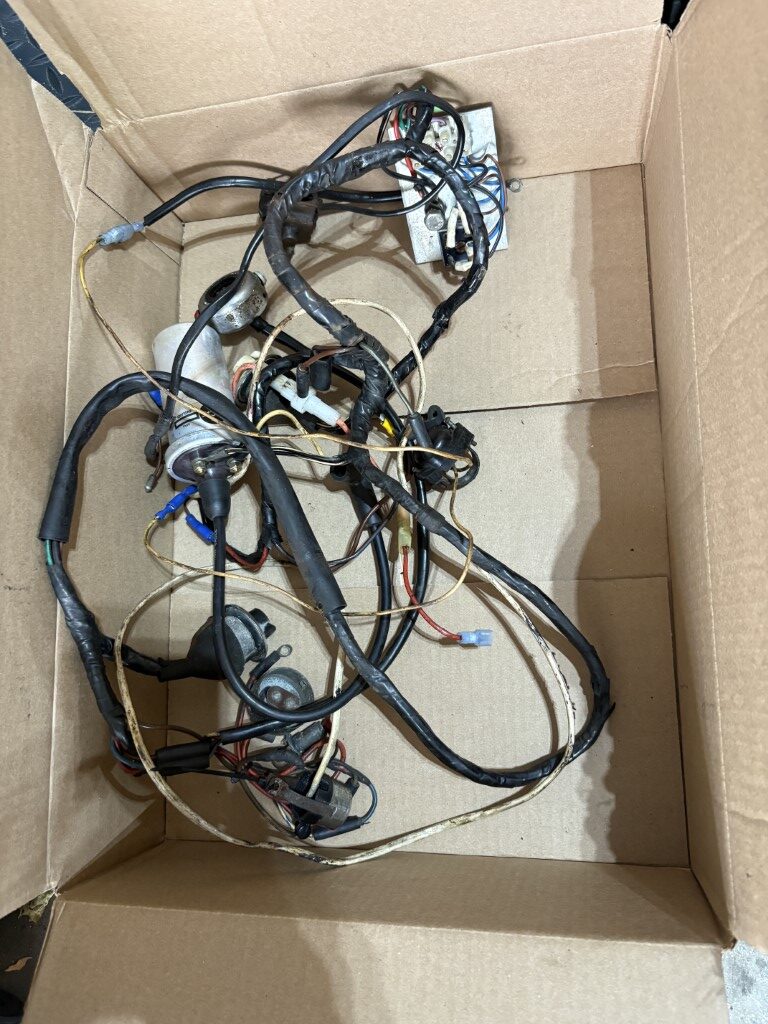
I don’t think that I shared, but one of my boxes has the entire electrical system in a box. At one point I’ll lay it out on the basement floor and the inspection and prep will begin. Figure lots of solder to fix and wire ends to replace. Even some connections to redo.

So, today’s progress: fewer brute-force hammerings, more accidental science experiments. The saga continues…

Who knew restoring a BSA would be 10% mechanics and 90% Googling creative ways not to bleed? H played nurse and I have an unphotographed Band-Aid on my finger… fortunately she said it’s got 60% faster healing properties to ready me for the next slip….

Posted in Uncategorized | Leave a comment

Tada…. small celebration (steering yoke)

The story continued today, but first was a shopping trip this afternoon with Holly to get some necessary components. I worked on the rear signals for the VN800 (’98), which now officially qualifies as “vintage” — not because of its styling or heritage, but because it creaks louder than I do getting out of bed.

In Ontario, the closest official definition is a “historic vehicle,” which must be at least 30 years old and largely unchanged from its original manufacturer’s product. While no specific “vintage motorcycle” legal definition exists, insurance companies and enthusiasts often consider vehicles over 25 years old to be “classic” or “vintage,” though definitions vary. Personally, I just go by the definition of: if the parts counter guy laughs when you ask for a replacement, it’s vintage.

Canadian Tire sold a set of their Extractors today which included the 13/16 size. With my pneumatic 1/2″ drive impact gun and some penetrating oil the nut finally gave up and the assembly fell apart. This is the point where the ball bearings scattered like confetti at a divorce hearing. I collected them, but in the end I have 45 out of the total 48. Many were stuck in the grease, and a few are now on extended vacation somewhere in the garage. Odds are I’ll find them months from now when they lodge in my shop vac hose or press into the sole of my foot.

The 3 missing bearings could have been casualties of time (disintegrated to dust)— or maybe they’ve already unionized and walked off the job in protest of poor working conditions. The upper race has dings, the lower has pits, and overall it looks like the bearings spent the last decade working as a rock tumbler. Replacement seems inevitable, which means I now get to research “fun things to do with a press and a blowtorch.”

This then brought me back to the footpeg on the Gearshift side of the bike (right). I managed to get the socket on the bolt end, and with the impact gun I cycled back and forth until it finally moved. Of course, it turned out to be left-hand thread. Righty-Losey, Lefty-Tighty… opposite. Nothing like questioning your entire life’s training in a single turn of a wrench.

Now the pedal itself appears stuck, likely on a tapered post. I’m debating if I should even bother removing it, since its main function at the moment is to introduce new bruises to my shins. If I leave it, at least I’ll always know where my shin bones are by the roadmap of purple welts. I did remove the rubber from the peg though, so progress… technically.

I now have an assortment of cardboard boxes breeding in the garage, each one containing a different section of the bike — like some sort of greasy advent calendar where the surprise is usually rust. Soon it’ll be time to start the part-by-part march toward recovery. A slow march, mind you… more like a good Scottish dram: steady, stubborn, and just cheerful enough to keep going despite the rain.

So that wraps up today. Three ball bearings on the lam, a left-hand thread that mocked me, and a shin that’s already filing a complaint. More fun to be had in the future… because apparently, I enjoy this sort of punishment.

Posted in Uncategorized | Leave a comment

Front end tear down – continued…

Today was a bit of networking to begin. Headed with my neighbor for a motorcycle ride to Chatham (103km) for breakfast with the CVMG (Canadian Vintage Motorcycle Group) members at “HUNGRY MAN’s” Family restaurant. Was a good meal and we had a nice ride back along River Line.

As for the BSA I continued today in the afternoon and goal was to remove at least the shocks and the sheet metal cover.

Starting with success this time you can see that I have removed the two shocks and the sheet metal.

I supported the front with a 4×4 cut to length to keep the ends of the forks slightly elevated off the floor.

I screwed in the nut to the top of the shock and then backed it off just one turn. I think used a 2×4 and applied some persuasion in the downward direction by laying the 2×4 on top of the nut. Once it dropped and closed the gap then I loosened the nut more and continued.

The shock slowly released from the taper fit and I was able to pull it out completely. The 2nd one (left) was slightly more difficult, but the same process worked and soon the two shocks were out and the sheet metal cover was released.

Pressure washing the frame in the driveway now that all the components are removed. Makes it a bit cleaner to handle as I get ready to strip it down for painting.

Tomorrow I plan to get apart the above assembly. I believe this was disassembled before as the component (E) already had rounded corners and the wrench was slipping. It’s rounded now that it will need to be replaced so tomorrow I’m going to consider some nut extractors or weld on a 5/8″ nut which can be used to get it moving.

To Be Continued…

Posted in Uncategorized | Leave a comment