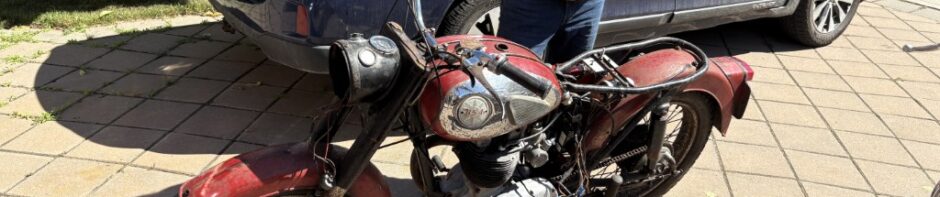
Of course like anything it takes time….
Course, like anything worth doing, it takes time… and in my case, a few muttered curses and a good helping of misplaced optimism.
First order of business was to get the wheels off the rims and the tubes out. Aye, tubes — remember those? Back in ’61 they actually put a balloon inside the tire to hold the air in. Revolutionary thinking, clearly. Likely the only reason the blessed things were still holding air after 55 years. Fair play to the old rubber, it had more stamina than me.
Before heading off to the swap sale recently, I figured I should at least take a squint at the spokes and how they were mounted. Couldn’t just walk in pretending I knew what I was talking about — though, truth be told, that’s usually my approach to life. So, off came the tires for a closer look.
Now, I’ve done plenty of bicycle tires in my day — usually with screwdrivers and my mum’s best butter knives (sorry, Mum). I was the local bike repair lad back then. Paint a frame, fix a chain, bodge a repair. I was also head demolition expert, but that’s another tale. Anyway, I quickly discovered that my trusty screwdriver wasn’t up to the job. In fact, it was about as useful as a chocolate teapot.
So I asked my mechanic pal Mario how he does it. He agreed to lend me his secret arsenal: three proper tire wedges and his personal BFH — that’s “Big Friendly Hammer” in polite company.

Like a Scotsman at an open bar, I was off.
Attack!
I’ll spare you the details of the huffing, puffing, swearing, and sweating as I tried to balance three tire wedges while whacking away like a man possessed. There are entire YouTube channels dedicated to this lunacy, if you fancy seeing other poor souls suffer. But the good news: I was successful. Even better news: I didn’t put any new holes in the tubes. (The old ones will do just fine, thank you very much.)
The rubber is older than a Highland granny, but I reckon it’ll be good enough to get the bike rolling. Once the test pilot’s done, we’ll swap it out for something a wee bit fresher — ideally before the thing disintegrates mid-ride and throws me (or the wifey) into a hedge.


Next came the delicate art of finesse — which in my case usually means brute force with a thin veil of patience. The two hub covers had to come off, and after a bit of persuasion with heat and a pair of wedge screwdrivers (the sort of nail pullers your grandad kept in a rusty tin), I managed to pry them up bit by bit. The heat worked its magic, softening the 50-year-old grease into something resembling day-old porridge, and slowly but surely the covers gave up.
With that, I coaxed the shaft and bearing out of the hub. Well, coaxed might be generous — let’s just say there was some convincing involved. The second bearing I left for a trip to Mario’s, since he actually owns a proper drift for the job. (I’d been about ready to try a tent peg and some choice language, but apparently there are “correct tools” for these things. Who knew?)


I’m down to a couple of tough ones remaining on the dismantle (other than the engine inspection)

Anyway, this race has to come out. Only problem: the frame hole is smaller than the inner race ID, so there’s no handy lip to tap from the other side. In other words, BSA designed it so you’d curse your way through the job.
At coffee morning, the lads told me the trick: put four spots of weld on it and, when it cools, the different metals shrink at different rates and the race just drops out. Aye, right. Sounds like black magic to me. I’d hate to dig out my book on thermodynamics (or worse, ask my wife to explain it).
Plan B: weld a big washer or nut across the race so it can actually be hit with a drift from the back. Or maybe it just falls out on its own when I’m not looking — that would be a first.
The other job (I did say two remaining) is to get the front and rear shocks broken down. Since the springs are under more force than a Scotsman guarding the last biscuit, special tools are required. Naturally, I’m making my own.


For the fronts, I’ve got to reach way down the tube to hook into those two opposing slots using the tool on the right — essentially a bit of pipe ground with two tabs. Then I can grab it with a plumber’s wrench and twist it free. The “proper” tool for the job is $126 CAD on eBay (plus shipping). Aye, very reasonable… if you’re daft. I’ll be making mine for the price of a bit of scrap pipe and a fresh blister.
The rears are trickier. I need to build a special pipe to compress the spring so the two chrome pieces pop out through the gap. Sounds simple, right? Right. Wish me luck — because the only thing standing between me and a flying chrome projectile is my homemade contraption and blind faith.

If you don’t hear from me again, assume one of the 4 the springs won.